Medical triage
Five Days at MemorialMedical triage is the process of sorting patients and setting priorities when the number of people needing care exceeds the resources available. In the account of Hurricane Katrina, the term names both a practical response to an overwhelming evacuation and a moral problem: every ranking can direct help toward some people while leaving others to wait, and a mistaken or undisclosed classification can determine who receives a chance to be rescued.
Origins and Competing Rules
The word triage once referred to sorting coffee beans; it later entered battlefield medicine through Napoleon Bonaparte’s chief surgeon, Baron Dominique-Jean Larrey. In the approach Larrey described, people with less severe injuries could wait while those dangerously wounded received prompt attention, without regard to rank or distinction. The principle organized care around immediate medical need, but did not eliminate the hard choices created by scarcity.
A different limit appeared in 1846, when British naval surgeon John Wilson withheld surgery from patients for whom it was unlikely to succeed. By 2005, some mass-casualty systems included a category for people considered unlikely to survive with the resources at hand. That category was designed for catastrophic circumstances, such as a war-zone bombing with far more gravely injured people than available ambulances or medics. It changed the question from who needed help first to whether some patients should receive no treatment or evacuation at all.
The book emphasizes that these are not settled or interchangeable rules. At the time of Katrina, at least nine recognized triage systems existed in the United States, yet little research had established whether commonly used systems achieved their goals or could inadvertently worsen survival. Evaluating outcomes is difficult in emergencies, and political embarrassment or a lack of financial incentive may also help explain the shortage of evidence. A ranking can therefore carry the appearance of technical authority without proof that its method works as intended.
Uncertainty and the Risk of Misclassification
A patient’s likely outcome is difficult to predict. In a small study described in the book, experienced rescuers assigned widely different categories to the same patients, and some people who might have survived were judged unsalvageable. Conditions can also change, and new resources may become available. Once a patient has been assigned a low priority, however, the need to reassess that judgment can be overlooked.
The danger is especially clear when a system labels people as beyond help. A mistaken classification may leave a patient with a real chance of survival without treatment or evacuation. Some experts therefore argue that patients thought unlikely to survive should still be treated or moved: after those whose severe injuries demand immediate attention, but before patients whose significant injuries can wait. This ordering acknowledges scarcity without making a low chance of survival equivalent to no claim on aid.
Memorial’s Evacuation Categories
At Memorial Medical Center, impending floodwaters turned the response into a race against the loss of power. Nearly two hundred patients needed to be brought to safety. In the initial command meeting, Susan Mulderick proposed sending the sickest patients first, including people dependent on life support or mechanical assistance, newborns, high-risk pregnant patients, dialysis patients, and two vulnerable bone-marrow-transplant patients. The proposal reflected the familiar urgency of attending first to those most medically endangered.
Doctors then established an exception: patients with do-not-resuscitate orders would be evacuated last. Four patients in the intensive-care unit were affected, including Helen Breckenridge and Jannie Burgess. A do-not-resuscitate order applies when a patient’s breathing or heartbeat stops; it is not the same as a living will requesting that life-sustaining treatment be withheld or withdrawn in a terminal and irreversible condition. Richard Deichmann later said he believed DNR patients had the least to lose if disaster struck, and mistakenly understood the law to require that they have a certified terminal or irreversible condition. The evacuation rule thus relied on a judgment about the meaning and implications of a medical order, not simply on a patient’s immediate need for rescue.
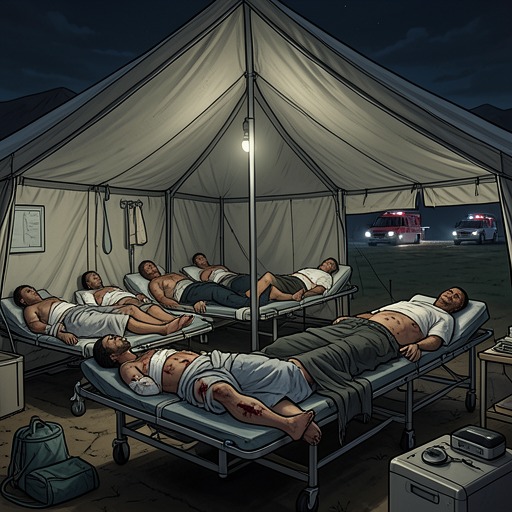
Later, in dim light, Anna Pou and other workers read charts by flashlight and marked patients with handwritten numbers taped to their clothing or gowns. Approximately three dozen patients from Memorial and LifeCare were designated category 1 and guided toward the emergency-room ramp, where Karen Wynn and Gina Isbell oversaw care as airboats began carrying patients toward dry ground. Around seventy category-2 patients waited along a corridor leading toward the parking garage and helipad. Roughly fifteen category-3 patients were moved to a corner of the second-floor lobby near a Hibernia Bank ATM and a planter of striped green dieffenbachia. Staff continued basic care, including changing diapers, fanning patients, and offering water when they could drink, while most other interventions were limited after patients had been moved from their rooms.
Pou and her colleagues had little, if any, training in triage systems and were not following a particular protocol. Pou later described the sorting as heart-wrenching and explained the shift from sickest-first evacuation to a different order as a response to the sense that not everyone could be saved. She would later invoke the goal of doing “the greatest good for the greatest number of people.” But a category is not a self-explanatory medical fact: it embodies a choice about what counts as benefit, which risks may be imposed, and who is entitled to make that choice.
Justice, Voice, and Authority
The book places disaster triage beside wider disputes about allocating scarce care. During World War II, the British military reserved limited penicillin for pilots and bomber crews. Before dialysis became widely available in the United States, hospital committees sometimes secretly used factors such as age, gender, marital status, occupation, and perceived future potential. Public outcry over those practices helped lead lawmakers to establish access to dialysis, generally at government expense. In South Africa, by contrast, shortages continued to force doctors to choose among patients, raising questions about social-worth criteria, unequal effects, patient notification, and the possibility of appeal.
Ethical theories point toward different priorities. A utilitarian approach seeks the greatest net benefit for a population, but critics argue that applying it to lifesaving care can demand unacceptable sacrifice from those most in need. A Rawlsian approach, as presented in the book, gives greater weight to need: people at the most imminent risk of death without care have a stronger claim on assistance, even if treating them delays help to more numerous patients with less urgent conditions. Other philosophers have argued for random allocation, both to give everyone an equal chance and to avoid granting individuals the power to decide who lives and dies. These approaches disagree not only about outcomes but about what can justly be compared across people.
Who participates in making the rules matters as much as the rules themselves. In organ-allocation discussions, the United Network for Organ Sharing included doctors and members of the public; public participants tended to favor patients in dire need, while health professionals more often favored those most likely to benefit medically. Involving both groups produced policies that combined concerns for justice and efficiency. At Memorial, by contrast, medical professionals alone categorized patients, and no system was established to inform those most affected. In some instances, staff actively withheld the reason for a delay.
That lack of information had immediate consequences. When a patient’s daughter learned that her mother’s DNR order was being used to defer evacuation, she said she had not understood it as an instruction not to rescue her mother. She asked for the order to be canceled; after a doctor was found to remove it, the patient was moved toward the helipad and survived that immediate ordeal. At LifeCare, Angela McManus also tried to rescind her mother Wilda’s DNR order, but staff told her no doctor was available. These different outcomes expose how a rule can be difficult to challenge precisely when time and access to decision-makers are limited.
Triage Beyond the Clinical Rule
The evacuation’s logistical decisions also revealed competing claims to authority. On the helipad, a nurse who was an Air Force captain offered her flight-line experience after a Coast Guard pilot departed to rescue people elsewhere amid an argument over how many patients his helicopter could carry. Deichmann put her in charge; she cleared the landing area and moved people away from the rooftops so pilots could land. Later, neonatal nurses refused to let a pilot take babies to a hospital other than the Baton Rouge destination that had agreed to receive them. Their nursing director insisted on a suitable flight plan, and approval followed. These encounters were not the same as bedside triage, but they show that allocation depends on practical expertise and that evacuation authority can be contested.
The comparison with public Charity Hospital further complicates any simple equation between extreme conditions and one inevitable response. Charity had flooded, lost power and basic services, lacked a helipad, and had more than a hundred psychiatric patients among a patient population about twice Memorial’s size, with fewer staff relative to patients. Its transfer of all patients took until September 2, a day after Memorial’s, yet fewer than ten patients died. Staff described continuing care in patients’ rooms and holding frequent lobby meetings that included everyone from doctors to janitorial staff. The contrast does not by itself prove that one triage policy caused a particular outcome; it shows that organization, communication, and institutional circumstances form part of the conditions under which triage operates.
Medical triage, as the book presents it, is therefore both a response to scarcity and a test of the systems that produce scarcity. Its categories can coordinate urgent action, but they are provisional judgments, vulnerable to error and bias. Their fairness depends on clear purposes, reassessment, meaningful communication, and an accountable process for deciding whose needs count. At Memorial, numbered tags made the ranking visible on patients’ clothes; the reasoning and consequences were not equally visible to the patients and families whose chances of rescue the ranking shaped.